

























The San Rafael City Schools district will need to make $5.5M in cuts in order to keep a balanced budget over the next two years. With a diminishing Covid grant, declining enrollment, and low reserves, SRCS has become a focus for the school board.
“What’s happening is financial frustration due to the one-time state Covid grant, the rising operating cost, and unfortunately, our declining student enrollment,” said Carmen Diaz Ghysels, the superintendent of the SRCS district.
The Budget Advisory Committee is a group of district staff, teachers, site administrators, principals, school board members, parents and community members who meet to discuss potential sources of reductions for the budget. They do this to give the district a community perspective on what is being done about the budget.
“They’ve had a series of evening, monthly meetings since August of this year and a little bit last year as well, where we look at potential cuts that we could offer up the school district,” said Joe Dominguez, SRHS principal. He continued by saying that most of those cuts will end up being staff positions.
A big source of funding is based on student enrollment or property tax revenue, whichever is higher. San Rafael High has been funded by enrollment, but because enrollment has gone down in recent years, that funding has changed to be from property tax revenue. As a result, the money from this source has decreased.
During Covid, school districts were given a large grant from the state meant to last for five or six years. For the past couple of years, SRCS has been fortunate enough to have an increasing revenue, largely due to the Covid grant. However, that money is almost used up, and the funding from enrollment, property taxes, donors, and so on isn’t sustainable. And so, certain expenses must be cut.
“It’s not that we are going broke,” said Lee Chretien, SRHS math teacher of 22 years and Teacher’s Union negotiator. “It’s just that we had this weird blip, where all of a sudden, we got this pot of cash, and we spent it, like we should have, and now we have to decide how we’re gonna live without having it anymore.”
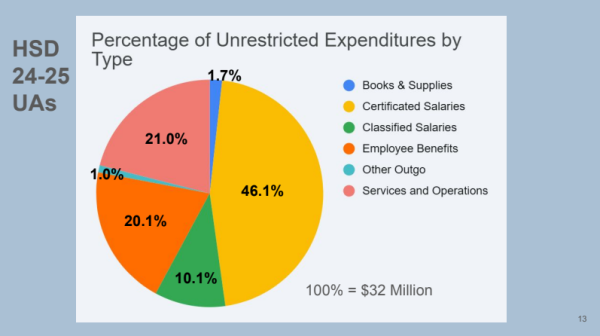
According to the September 2025 Budget Advisory Committee presentation, employee salaries and benefits take up 76.3% of the $32M unrestricted expenditures the district pays.
Matt Winton, a 25-year history teacher at SRHS and vice president of the Union, said, “They’re going to cut somewhere around 4 to 5 teachers for next school year.”
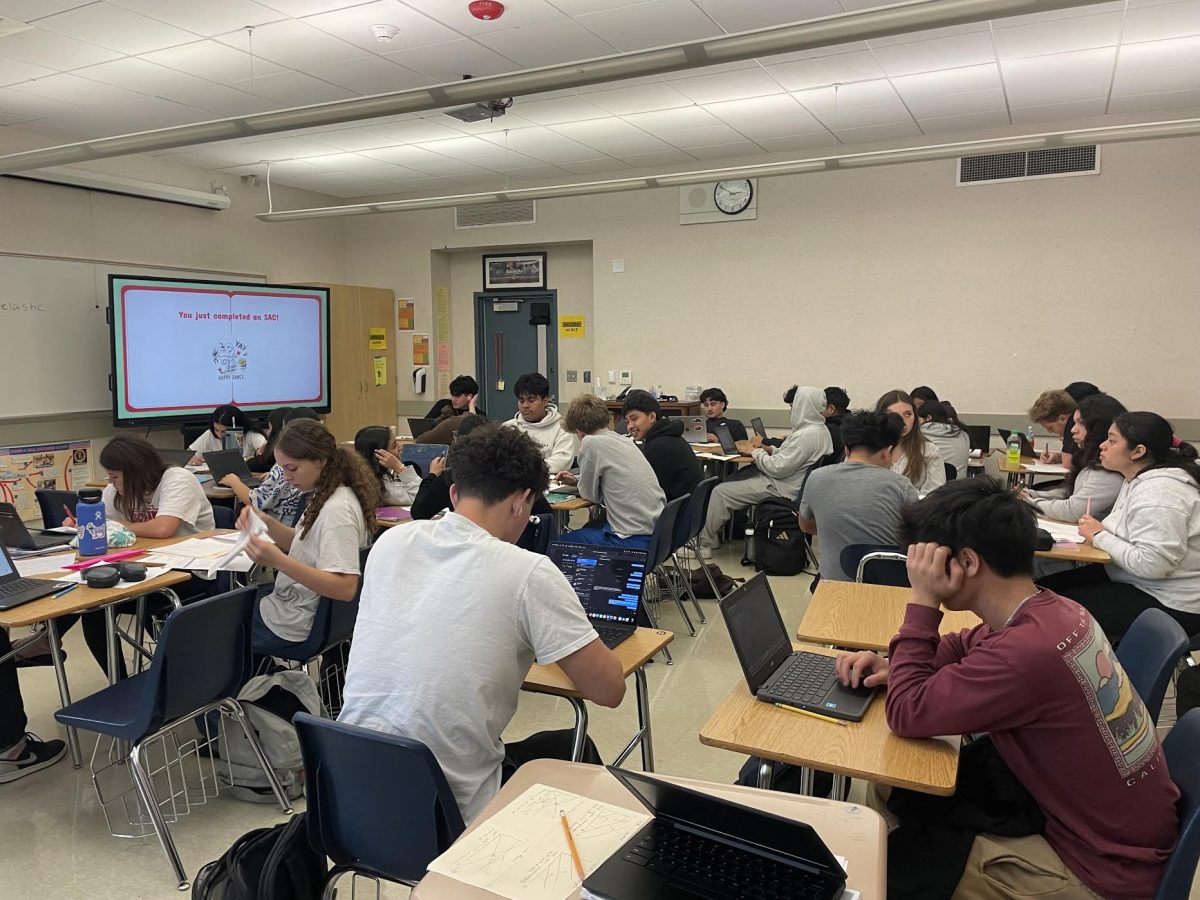
Although it may seem unfair to cut teaching positions, it makes sense, as the district has recently had a decline in enrollment, notably in newcomer students. SRHS typically expects over one hundred newcomer students to join the student body, however this year, they only had four.
“We built our classes the last two years, starting with a few expecting them to fill up, but they never fill up,” said Mr. Winton. “So we have classes and there’s like three students, mostly newcomers, ELD, Bridge.”
“This is probably due to the government and ICE’s recent efforts of pushing for a mass deportation,” Ms. Diaz Ghysels said. “It could be the state of the country right now with everything going on, maybe impacting that.”
Teaching positions are already at risk of being cut, but newcomer teaching positions may be in even more danger. “If you have specific positions like a newcomer counselor or you have teachers that teach specific sections for newcomers, and you don’t have the newcomers, then those are areas where we need to make some reductions,” said Bob Marcucci, the deputy superintendent of business services for the SRCS district.
While the cuts to classroom staffing are a definite reality, school administrative/ management positions are being offered as reductions as well. For the high school level, $570,000 of these kinds of positions were offered. There are also district office/management position cuts being offered; however, they only total $75,730, much less than the money being cut from the schools.
There are various reasons for this imbalance in staff cutting. For one, the staff body at the school level is much larger than the staff body at the district level. On top of that, schools hired many new staff members post-covid, whereas the district did not, according to Marcucci.
Additionally, Mr. Marcucci explained that there are certain positions in the district office that can not be cut, due to federal and state compliance requirements. “I would say that the cuts are proportional to the number of staff at each level,” he said.
The budget must be seen over a three-year period called a multi-year projection, and we’re currently in year one of three. The district plans to implement these cuts in the 2026-2027 school year, and then either make more or not based on economical factors in 2027/2028.
“In 2026-27, we will make the cuts we need to make and get ready for that one-time Covid money to go away,” said Ms. Diaz Ghysels. We will continue to implement reductions or we’ll see where our expenditures are and how the general fund is, how this governor’s budget is, and we’ll monitor all those one-time funds that are starting to go away.”
In the third year, the district is expecting to be short on money, and would have to dip too far into our reserves, which are already below the board’s expectation of 17%. Making cuts and minimizing the budget would help us increase reserves, prepare for the end of the Covid grant, and improve the teacher-to-student ratio.
Mr. Dominguez said, “There’s an expectation that we adjust our budget, so we can build a reserve, have a plan for what we’re going to do when the Covid dollars end and address our staffing as it pertains to a declining enrollment.”
Nearly $589,000 needs to be cut from the budget in this upcoming school year because last year, we spent $589,000 more than we brought in. Additionally, we need to find a source of money to replace the $1.3M of annual expenditures for Covid dollars.
“We have an immediate problem that we want to at least cut $600,000 from the budget, and then we have about $1,300,000 that we need to solve before we run out of that Covid money,” said Mr. Marucci. “If we cut some of those things now, then the other things that we’re funding with that mo
ney could maybe last a little longer.”
If everything plays out smoothly, it’s expected the cuts should balance out the budget, and there shouldn’t be major impacts to students. The two things that may be of concern are larger class sizes and a loss of courses with low demand.
“It could be that some courses make it, but there are smaller sections being offered. Or, some courses are not offered in the following school year,” said Ms. Diaz Ghysels. “We have to, of course, offer our core, but I think it depends on the needs of both the sites. What Terra Linda needs and what San Rafael needs.”
This means that fundamental courses like math, English, science or history may have larger class sizes, and ones that not many students are taking, like newcomer classes, are at risk of being cut. However, only a couple teachers are expected to be cut in our district, so there probably won’t be cuts of entire courses, just the fixing of under enrolled classes.
“I don’t feel as if there are going to be major impacts on students going into next school year,” said Mr. Marcucci. “There might be a few more kids in a classroom, potentially, in some areas, but I’m not hearing about major cuts of entire programs or anything like that.”
Simmons • Feb 27, 2026 at 11:28 am
Found and fixed, Mr. Boris! : )
Evan Boris • Feb 26, 2026 at 8:21 pm
I believe English, whether the description of the people of England or the subject of the language is always capitalized? Otherwise, I enjoyed reading the article 🙂