








No sunglasses perched on your head. No bare shoulders. Pants must fall below or at the knee level. No loud talking. No laughter.
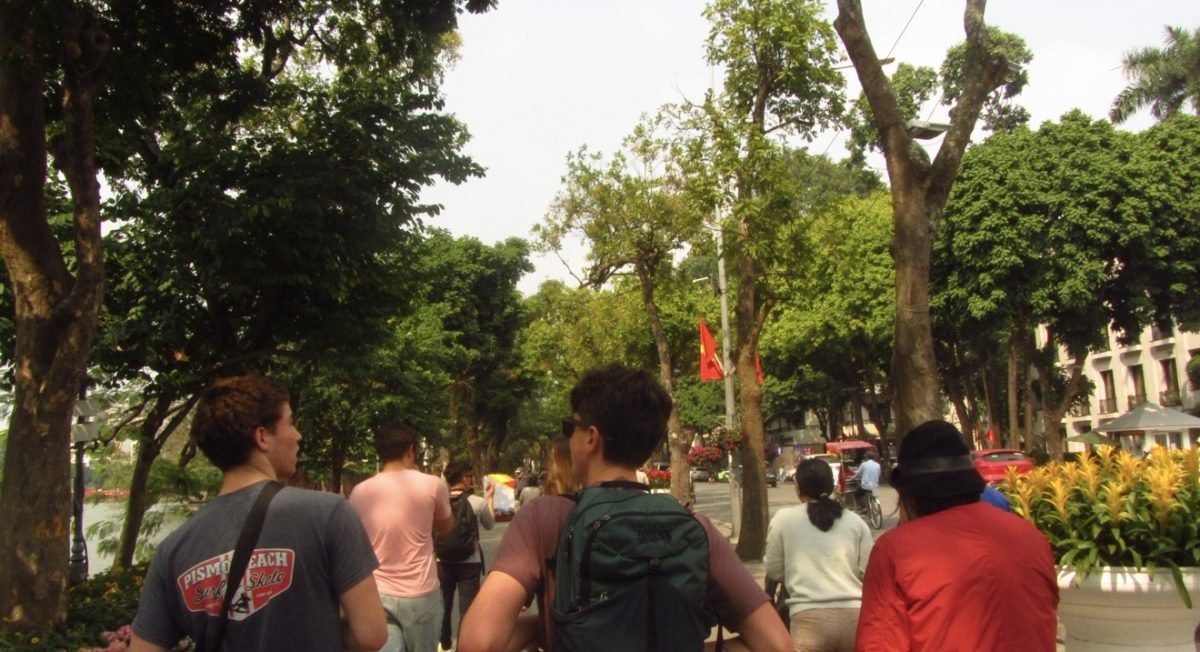
Before we even stepped inside the Hồ Chí Minh Mausoleum, the atmosphere was tense. Guards lined the entrance in rigid formation, watching each person carefully as we walked in. Their presence immediately silenced the humid, chaotic energy of Hanoi’s streets. It was nearly 90 degrees, yet inside the mausoleum, it was cold. Not just air-conditioned cold, but an unsettling chill crawling up your spine. The higher we walked up the stairs, the quieter it got.
At the center of the dim hall, under stark lighting and constant surveillance, lay the preserved body of President Hồ Chí Minh. He was encased in a glass coffin, guarded on all sides. Everyone was now in a single file line, walking slowly along the thick railings that separated him from the rest.
Below him, four guards in white uniforms stood completely still with their hands pressed flat against the side of their thighs. More guards were placed every few feet around the room, overseeing closely, ensuring no one stopped walking, no one took photos, no one broke the silence.
If you ever go, Hồ Chí Minh is dressed in a simple formal suit. Our tour guide, Thang, told us that “Uncle Ho” is what people across Vietnam call him. The government chose to preserve his body instead of following his wish of being cremated. This way, people could come to see him and pay their respects. We learned that every year, for annual maintenance, the mausoleum is closed for two months.
I felt as if I traveled back in time and lived through the terrifying war moments when we visited the Hỏa Lò Prison. The space is tight and dim. Rooms and prison cells were filled with original artifacts, faded handwritten notes, worn prison uniforms, and rusted bed frames. Then there’s the guillotine. It’s just there, in the open. Something that was actually used not that long ago. Behind it were pictures of those who got executed. I gagged. I’ve never looked away so fast. I hid behind my friends, so I didn’t have to see the gory photos of lifeless heads while our tour guide spoke.
And that’s the larger point of going on an international school trip. History becomes more than dates in a textbook or short clips on social media. Sometimes it’s inspiring, other times horrifying or deeply uncomfortable. But standing in those spaces forces you to confront the historical events in a way a classroom never could.
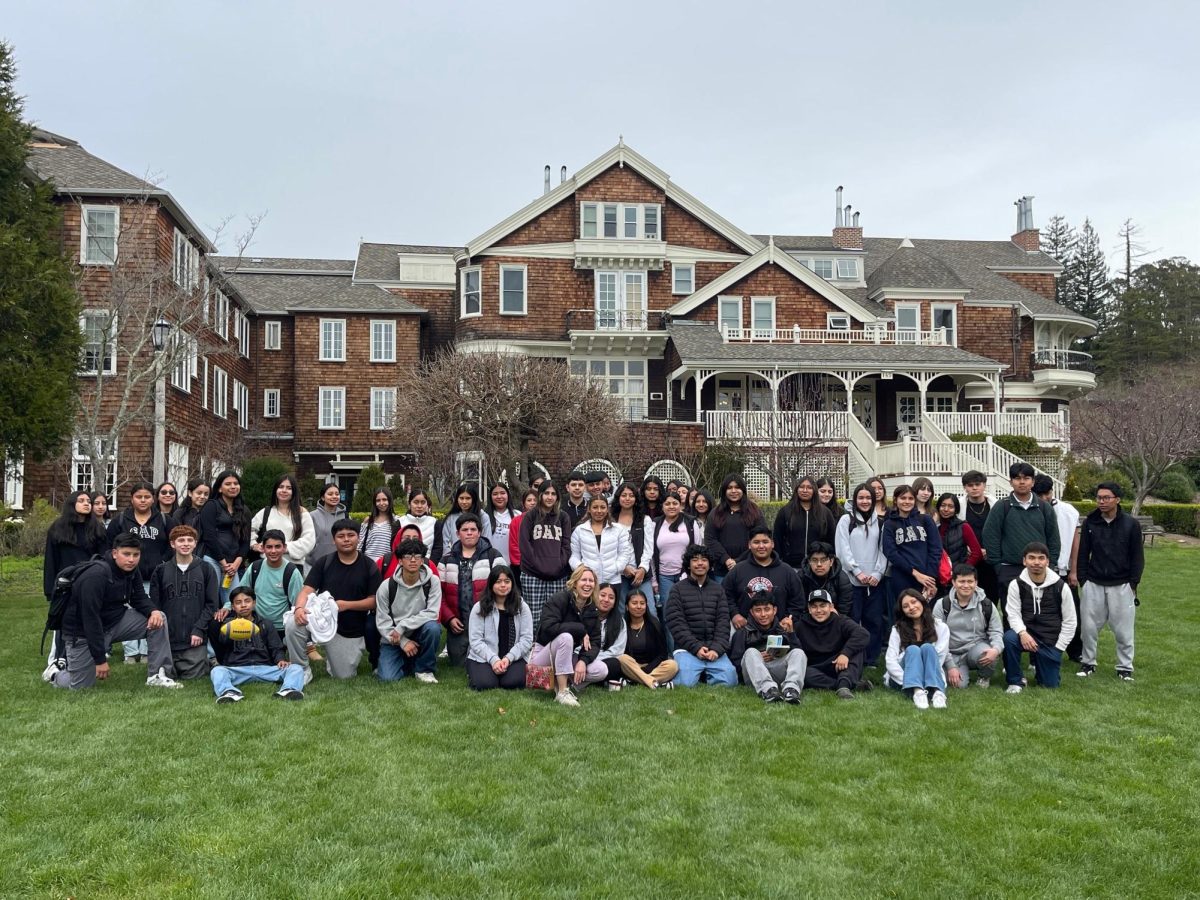
I had these experiences on the 2026 trip to Vietnam, led by a SRHS teacher, Madame Truett, a French teacher, through Education First (EF) Tours, a private travel company that partners with educators to bring students abroad. Trips occur over winter, spring, and summer breaks. But as immersive and fast-moving as those ten days felt, not every student gets to experience Vietnam this way. The Vietnam EF (Education First) trip was one of several international tours led by teachers at the school through EF Tours. Promoted across campus, these trips are often framed as a once-in-a-lifetime opportunity that offers cultural immersion, creates memories with friends, and provides education outside of the classroom.
Myrna Escamilla, a senior at SRHS, stated the Italy trip during the spring break 2025 was her first time ever being on a plane. “No one told me about the turbulence,” said Escamilla. “It really scared me because the plane kept shaking.”
The flight was full of new experiences for her, from sitting in the middle seat round trip to adjusting to the cramped airplane bathrooms, tight seating, and bland airplane food. Despite the rough flight, Escamilla said arriving in Italy made the experience worth it. She was especially surprised by how different the infrastructure felt compared to the United States. Unlike America’s car centered cities, she noticed how walkable Italy was.
“I had gelato twice, if not more, everyday,” said Escamilla. “I would try different shops, and the gelato was so good everywhere I went. It’s a lot creamier and doesn’t melt as quickly.”
But with the price tags reaching thousands of dollars, not every student has equal access to that experience. While some return with stories, photos, and new perspectives, others are left watching through a screen on their friends’ social media, wondering what it would have been like to go.
Emma Lawson, a junior at SRHS, had originally planned to go on the Vietnam trip but ultimately decided not to sign up. While cost played a role, so did the timing and academic pressure. “It’s really expensive,” said Lawson. “Not everyone has that kind of money.” Her mom was hesitant about her missing important time during the academic year and was skeptical about the structure of the trip, moving from place to place on a set schedule, which made it seem like the students wouldn’t have the opportunity to experience the country the way they wanted to.
Still, watching the trip unfold from a distance through her friend’s social media, “I saw the photos, and everyone looked like they were having so much fun,” said Lawson. “I definitely had that ‘I wish I went’ feeling,” said Lawson. The sense of missing out highlights those who feel like they’re just outside of the experience. “I felt happy for everyone on the trip. I saw the Instagram posts. Everyone looked like they were having so much fun.”
Madame Truett, has been organizing international trips for students, bringing groups to countries across Europe and Asia through EF Tours. Growing up in Arizona, she saved for her senior trip abroad by shining shoes at resorts, eventually earning enough to join a teacher-led tour through Europe after high school.
That experience stuck with her. Not just the places she went, but the feeling of traveling with other students, figuring things out together, and being away from home in a new culture. Years later, after becoming a teacher, she decided to create that same kind of experience for her own students. She began planning her first trip in 2015 and took her first group, mainly her French students at the time, abroad to France in 2016. Since then, the Vietnam trip was the fourteenth trip that she led.
“It’s a lot of work. Sometimes it feels like another job, but every time I lead one of these trips, it’s an inspiration,” she said. “Students become more independent, more confident. For some of them, it’s their first time on a plane, their first time out of the country without their family.”
Connections while traveling are also different. “We get to have great conversations. There’s no bell ringing. There is no curriculum, aside from just experiencing what’s around us,” she said. “It’s truly a mission, even though it is a lot of work; the payoff is I get to have these experiences with you all.”
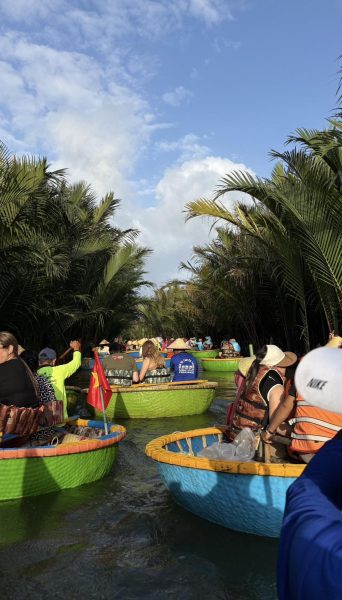 For Levi Rivera, a senior at SRHS, the experience went beyond just visiting a new country; it was about connection. Having gone on both the 2025 Japan and 2026 Vietnam trips, she describes each one as an opportunity to not just learn, but to build relationships in a completely different environment. “I made a lot of new friends that helped me navigate Vietnam, and in return, I would also help them,” said Rivera.
In Vietnam, one of the most memorable moments for her wasn’t sightseeing, but sitting down and listening to a Northern Vietnamese war veteran speak about his life, his experience being drafted as a college student, his pivotal pilot role during the war, and how much he longed for the friendship with these American soldiers if it hasn’t been for the war. “It made me realize how valuable human connection is,” said Rivera. “It changed the way I see history.” Experiences like that, she explained, “I learned a lot of history that I don’t think I would have learned in a classroom.”
“History plays a giant part and a pivotal role in society.” Rivera acknowledges that history is being taught and retold with bias in the context of a country or side. Being physically present, hearing stories directly, and seeing places firsthand made everything feel more real and personal.
In Northern Vietnam, you don’t just learn about history. You actually live it and move through it piece by piece. Rather than looking at images and studying historical events through textbooks, we get to see history right in front of us.
***
In Hội An Ancient Town in Central Vietnam, everything felt different. The air was warmer, and the streets are more vibrant due to the Lunar New Year celebration. Lanterns hung everywhere; bright reds, yellows, and blues silks were painted with intricate embroidery and artistic calligraphy. Once the sun goes down, it lights up the entire town, reflecting off the buildings and the river.
Both sides of the streets are paved with fabric shops, each one offering to tailor clothes that are ready within a few hours. There were small street food stands, tea shops, and coffee spots tucked into corners you stumbled into.
If you looked closely, you’d find narrow alleyways between buildings. Some were so small that you had to walk single file, brushing past the wall as you moved through. You don’t really know where they lead. You just keep walking, turning, guessing, and miraculously, you come out on the other side of town. It feels like getting lost, but in a way that leaves you in awe.
Down by the Hoài River, everything slows down. People gather along the edge, releasing floating lanterns into the water. The lights drift slowly with the current, reflecting in soft, flickering colors. Small wooden boats pass through, carrying visitors along the calm river.
Along the sidewalk, vendors cut fresh fruit right in front of you: sour mango, tamarind, ambaralla, or press sugarcane to make sweet, refreshing juice. There’s always something to look at, something to try, something to buy: traditional dangling hair pins, nón lá, or small trinkets stamped with “I ❤️ Vietnam.”
The trips are promoted around campus through posters, announcements, and word of mouth, which slowly builds interest among students over time.
“Usually I give a two-year window, which hopefully allows people a little more wiggle room,” said Madame Truett. “I don’t mind opening trips really early. I’m happy to do that. I really want to make it as affordable as I can for students.”
This allows students and parents time to plan, save, and decide whether the experience is something they can financially commit to. “I can’t control the price of this trip, but I can try to the best of my ability to control how early I open it,” said Madame Truett.
Unlike sports, where students can fundraise on campus, the trips are organized through EF Tours and aren’t school-sponsored or affiliated. “I’ve tried out-of-campus fundraisers, and I have very little participation in them, which is why I don’t do them anymore,” said Madame Truett. She also mentioned that EF Tour also offered a scholarship for students to fund these trips. Each year with the support of the EF Global Scholarship Fund, they’re able to offer travel scholarships to as many as 100 students from around the U.S., with each award being $1,000.
For Madame Truett, the goal isn’t just to take students somewhere new, but to give them an experience that lasts after the trip is over. She acknowledged that the price tag can give people a reason to hesitate. “You can’t get that time back. You can’t get those memories back,” said Madame Truett. Referring to the students who have gone on the trip, she said, “For you guys, you have these memories and experiences that you can hold with you forever.”
For many students, the value of these trips isn’t just where they go, but what happens while they’re there. Being in a different country, away from family, school, and anything familiar, forces a sense of independence that doesn’t really exist in a classroom. Students share rooms, navigate unfamiliar places, and spend nearly every hour of the day with the same group of people.
“You learn that you can count on yourself,” said Mr. Baker, a math teacher at SRHS who was also a chaperone on the Italy trip. “[Students] find out they have resiliency,” said Mr. Baker. The growth isn’t always obvious; sometimes, it shows up in smaller ways, like conversations that wouldn’t normally happen at school.
Mr. Baker recalled there were three to four students in his class who went on the Italy trip. One of them had been struggling in his class. She was quiet, nervous about her math skills, and having trouble making it to his class. “Unlucky for her, she had to sit next to me on the plane over to Italy,” said Mr. Baker. “We sat and chatted the whole time, you know, not about math, but just stuff. She got to meet my wife, and we all chatted.” Not once did he question why she was not consistent with her attendance. “I didn’t want her on that trip to feel uncomfortable,” said Mr. Baker.
“After we came back, she didn’t have any trouble coming to my class at all,” said Mr. Baker. “It was kind of wonderful, all of a sudden, she liked coming to my class.” The shift didn’t come from a lecture or an assignment, but from simply spending time and getting to know a person outside of school.
Mr. Baker described the students on the Italy trip as phenomenal, mature, and responsible. After visiting Saint Peter’s Basilica, they had to leave for the airport at 7 a.m., which meant everyone had to be up by 4 am. As a chaperone, his role was to ensure everyone knew the schedule. “I set my alarm for 3 o’clock, get up, shower, knock on one of the kids’ doors, and they answered, fully clothed, ready to go,” said Mr. Baker. He was surprised that they got up so early.
“Mr. Baker, we just didn’t go to bed,” they told him.
Having gone on both the Japan and Vietnam trips, Julian Calderon, a senior at SRHS, described the difference between learning in a classroom and being in a country firsthand as something that’s hard to compare. “You can learn about a place in school, but you don’t really understand it until you’re there,” said Calderon.
In Vietnam, that understanding came through small, everyday moments as much as the major sites. Watching how people moved through the city, learning basic Vietnamese phrases, and noticing differences between regions. “Learning the difference between the North and South, the culture, the food, the etiquette,” said Calderon.
***
The last three days of the trip take place in Hồ Chí Minh City, also known as Sài Gòn.
Everything in Hồ Chí Minh City, also known as Sài Gòn, is on 2x speed. It’s loud in a completely different way from Northern and Central Vietnam. Motorbikes fill the streets, moving in every direction at once, weaving through traffic, barely a moment where things feel still. With over eight million people, the city feels like it never sleeps. “It’s like the New York City of Vietnam,” said Calderon.
Just steps from our hotel, located in the middle of District One, stood Bến Thành Market. Crowded with vendors selling everything from souvenirs to local specialties. A short twelve-minute walk led to Nguyễn Huệ Walking Street, where the infamous Café Apartment rises, nine stories of small, coffee and restaurants stacked behind a single facade. From a balcony above, the city opens up below, especially during the Lunar New Year, when flowers shaped into snakes, the zodiac sign of 2026, line the streets with people taking photos with their family.
For a wider view, take a twenty-minute taxi trip to Landmark 81, the tallest building in Vietnam. From the top floor, the city stretches out in every direction. Here, you can admire the hustle of Hồ Chí Minh City.
But some of the most memorable moments happen at street level. Sitting on a small plastic stool, eating a plate of Cơm Tấm on a bright blue plastic table, or biting into a crisp Bánh Mì, eating while walking. In a city that never seems to pause, these simple meals feel grounding.
Southern Vietnam isn’t quiet or reflective; it’s alive, restless, and in constant motion, and you just learn to move with it.
Growth on these trips comes in different forms.
Ms. Fortune, a math teacher at SRHS, who has chaperoned multiple trips, including Japan in 2024 and Italy in 2025, says that what happens behind the scenes is just as important as the destination itself. Her role isn’t just to supervise, it’s to manage a constantly moving group of students in unfamiliar places. Making sure everyone knows where they need to be, keeping track of schedules, and stepping in when something goes wrong all become part of the job.
“You’re dealing with a lot of different personalities,” said Ms. Fortune. “People have different expectations, different energy levels, and sometimes that leads to conflict.” Traveling in a large group means students don’t just experience new cultures, they also have to learn how to exist with each other. “As a chaperone, it’s my job to handle those situations,” said Ms. Fortune.
At the same time, those challenges are what make the experience meaningful. “It really sets you up with a safety net to learn about travel and maybe grow a passion for it or maybe decide its not for me,” said Ms. Fortune. For many students, it’s their first time navigating airports, keeping track of documents, and making decisions without relying on their parents.
Levi Rivera emphasized that the structure of the trip played a big role in shaping that experience. With a balance between scheduled activities and free time, she felt like she was able to explore while still being guided. “There was time to do things on our own, but also time where everything was planned out,” said Rivera. “It felt really organized.”
For Rivera, that balance and overall experience made the trip feel worth it. But she also acknowledged that going on the trip wasn’t simple, “It was my birthday present, two years ago. I was just waiting for the time that I could go, which was my senior year,” said Rivera.
She helped pay for part of the trip herself, saving money from jobs and paid internships, while her parents covered the rest. “There are different payment plans for different people,” said Rivera. “They’re a bit pricey, but it’s definitely not impossible if you plan strategically financially. It’s doable.”
When asked why it is important for students to have an education outside of the classroom, “Inside the classroom is important, but there’s a whole other world out there outside of high school,” said Mr. Baker. “When you’re in high school, do something big because you’re going to remember it for the rest of your life.” Mr. Baker acknowledged that although academics are important, “You’re not going to remember your math class for your entire life, but you will remember it when you’re in Italy or Vietnam with your friends.”
When asked what values students learn on these trips, based on her observation, “You learn how to be in a group. You learn independence, but also how to compromise.”
“It really gives you perspective,” said Ms. Fortune. “We get so used to our own lives, and then you go somewhere completely different and see how other people live their lives.” Even for her, the experience continues to evolve. Having traveled to Italy before, she said, seeing them again through students’ eyes changes the experience entirely. “I have already been in Italy, enjoying my gelato, but to see the kids there for the first time, being like ‘this is so great’ really adds to it,” said Ms. Fortune. “I’ve been and done things for granted, but to see how much people enjoy it for the first time, I really love that.”
Like others, he felt the experience lived up to what was advertised, if not more. While the itinerary outlined the main activities, he said the reality of the trip often went beyond what was expected. “There was way more than what was listed,” said Calderon. “You end up doing more than you think.”
Part of that, he explained, came from not having to plan everything yourself. Traveling somewhere far from home, especially a place with language barriers and cultural differences, can be overwhelming, and having that structure made the experience easier to focus on. “You don’t really have to worry about anything,” said Calderon. “You can just enjoy it.”
Pamela Santa Rosa, a junior planning to attend an upcoming EF trip to France and Switzerland late this June, has access that looks different. “My parents are working extra so I can go,” said Santa Rosa. In the months leading up to the trip, she’s been more aware of how much it costs. Spending habits have shifted. She saved her weekly allowance, cutting back on small purchases, and thinking more carefully about money.
“If I want to spend money over there, I can’t really spend much here,” said Santa Rosa. Even with that effort, she recognizes that not every student has the same option. “Not every student has parents who can just work extra or afford something like this,” said Santa Rosa. Across all three experiences, missing the trip. The opportunity may be available, but the ability to take it isn’t the same for everyone.
“Opportunities are equally available to all students; there’s no requirement to be able to go. You don’t have to have a certain GPA or grades to be able to go.” said Rivera.
On the other hand, “These trips aren’t really accessible for everyone in terms of financial reasons, but also documentation. It’s not a reality for a lot of people,” said Calderon. The whole cost is often the most visible barrier. Requirements like a passport, travel documents, and the ability to leave the country add another layer that can quietly exclude students before they even consider signing up.
But like many students, Calderon’s ability to go on these trips was tied to financial support. His parents funded both of his trips, something he recognized not everyone has access to. “The opportunity is there for everyone, but financially, it’s not realistic for a lot of people,” said Calderon. He still believes in the value of the experience itself: “Money comes back, but experience like this, especially at this age, doesn’t.”
Alex Macias, a senior at SRHS who previously participated in the EF Japan trip, had planned to go on the Vietnam trip as well. This time, he couldn’t. “I feel like it’s definitely not accessible,” said Macias. “A lot of people would really enjoy the opportunity to go overseas somewhere, but they just simply can’t because of the financial component.”
Having already experienced one EF trip, he understood what he was missing.
The Japan trip had been his first time traveling to a country where he had no personal connection to the culture. Being surrounded by unfamiliar language, food, customs, and people encouraged him to experience something that is different from what he was used to.
“It was my first time traveling outside of the country where I have no relation to the culture,” said Macias. “Just immersing myself in the country, the people were what was life changing.”
But for him, the experience wasn’t only about Japan itself. It was about who he experienced it with. Traveling with classmates meant seeing different sides of people outside of school hallways and campus. Long flights, navigating train stations, trying new foods, and spending nearly every hour together created friendships that flowed differently than at school.
“When are you ever going to go to another country with your high school friends?” said Macias.