










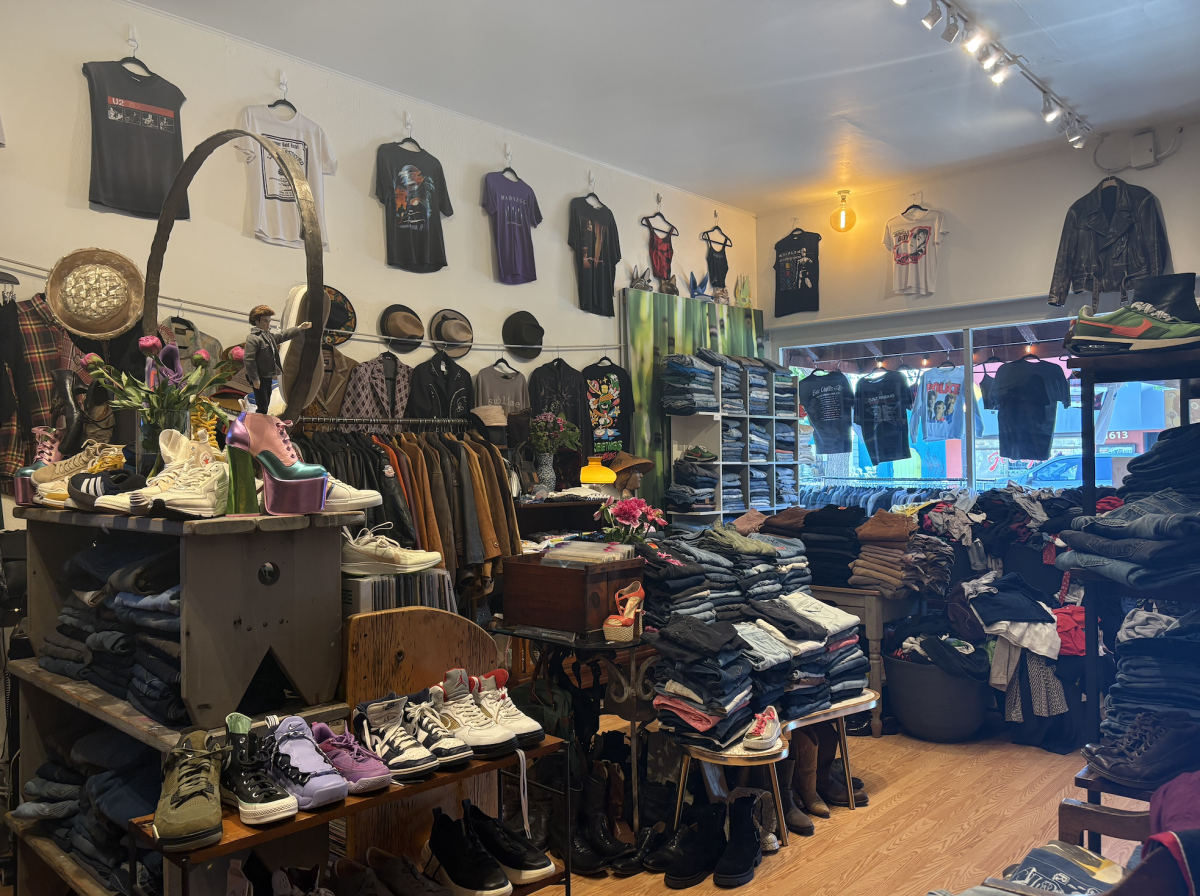









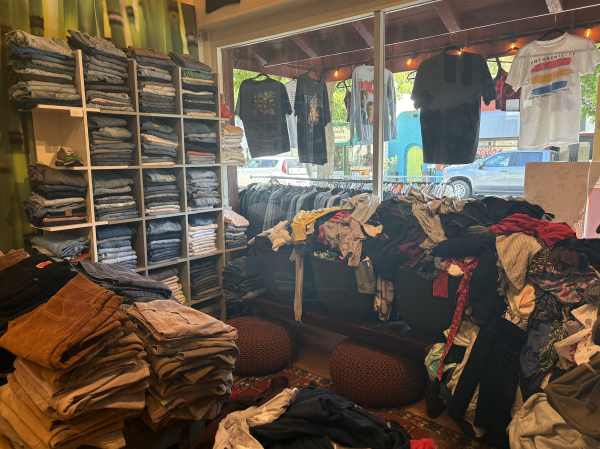
On 4th St. in downtown San Rafael lives a small thrift store named West End Vintage. Clothing racks line the store’s walls, cowboy boots line the floor, and a table is stacked with 2000s jeans. Blasting throughout the store was “You and I” by Rick James from a record player connected to speakers. I was there on a sunny Wednesday during my spring break. I started by hunting through a collection of boots on the shelf. Cowboy boots were my main target because I needed a pair for Outside Lands, a three-day concert in August.
Next to me, two high school girls sifted through the “$5 bins.” Inside were clothes donated by locals or pieces that had been on racks for too long. Six bins, all of which were overflowing with different clothing pieces that people dug through, hoping to find the “hidden gems.” I call these bins a “volcano eruption,” but instead of lava, it’s a bunch of clothes lumped together.
To me, thrifting is a sport that comes with back pain, uncertainty, and complete patience. You plug in your AirPods, put on your favorite playlist, and start digging. I found a crochet multi-colored bean bag chair buried under a mountain of clothes and took a seat. I began looking through the heaps of fabric alongside the two girls.
I pulled and grabbed each color that seemed promising. Thrifting is all about finding that something in nothing. I held up a random teal T-shirt and scanned it with my eye. I wasn’t 100% sure about it, so I glanced over to the two girls and asked for their thoughts. I had to start our newfound friendship somewhere. They both looked young and sincerely focused on the hunt for something good. Their names were Kate Wuertz and Aliyah Essman, both freshmen at Archie Williams High School.
They agreed that it was cute, and I put it in my “want” pile next to me. As the three of us kept looking through the volcanic eruption, I thought the best people to ask about teenage thrifting were the girls next to me.
“I like it because it’s different,” said Aliyah. Kate nodded and agreed. As we kept chatting, I pulled out a Brandy Melville piece from the $5 bins. It was a knitted grey wrap that usually sold for $28, and I could feel the burn of a glare.
After an hour of digging, I needed to take a break. I scored three pieces: a teal T-shirt, a Brandy Melville wrap, and some pants that miraculously fit me. As I was getting up to leave and pay, the owner came up to me and said, “San Rafael High School, right? I heard that you’re writing an article. That’s pretty cool.” As I nodded, I scanned his appearance. I would describe him as a cool uncle, one that sneaks you ice cream without your parents knowing, or someone who was in a garage band as a teenager with all his friends. Talking to him was like talking to an old friend: easy and familiar.
This man’s name was Michael Pringle, and he is the owner of West End Vintage. I found out he was born in San Diego, where he began his love for thrifting. Growing up, he would go to garage sales and thrift stores with his twin brother, which they both bonded over. Thrifting slowly became a part of his life when he worked at and owned thrift stores in San Diego, then Hayes St., and now two stores on 4th Street.
As we kept chatting, I asked him why he liked thrifting so much. He thought about it for a minute and responded, “When you’re thrifting and find that gold mine… there’s nothing like it.”
After finding a parking ticket on my windshield, I left to go home and think about my conversations with Michael Pringle. What I kept thinking about was whether the culture around thrifting was the same back then. Did teenagers in the past thrift for the same reasons as current teenagers?
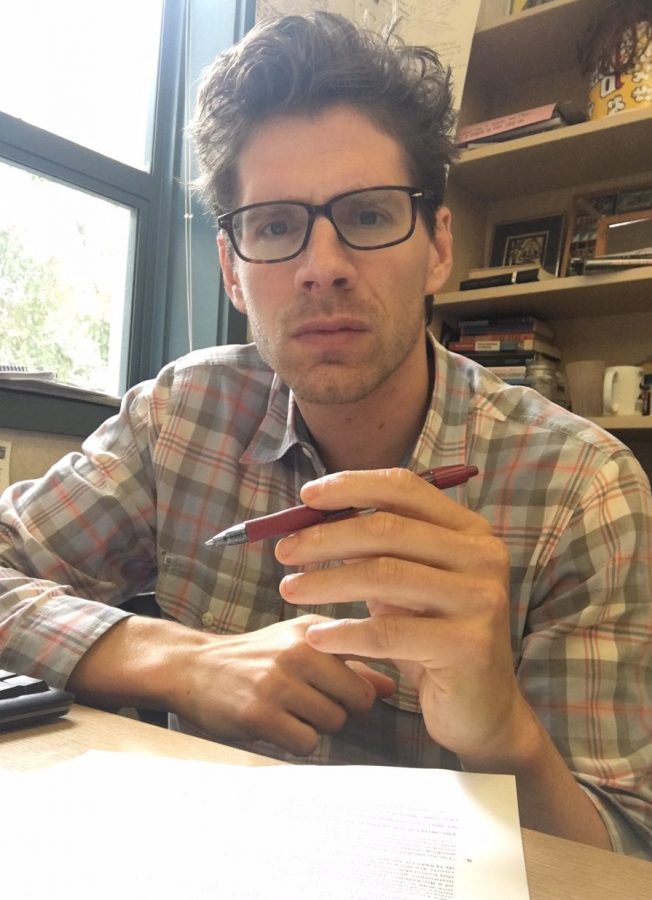
Mrs. Kilgariff, a longtime staff member at SRHS, is described as “she has such great hair and even better style!” said Wendy Rodriguez, an SRHS senior. I decided to chat with her about when she started thrifting, and “If you count hand-me-downs, my entire life!” she laughed, explaining that thrifting wasn’t always a “trend,” but something she grew into. When she began consciously thrifting, it was in middle school, around the time she stopped getting hand-me-downs.
Now, her approach to shopping is almost entirely secondhand. “I always check to see if something I want is available on places like Depop or ThredUp before I buy anything new,” she told me. For her, thrifting isn’t just about clothes, it’s about intention. She described it as a way to step away from fast fashion and trends and instead choose pieces that actually speak to her. “It makes fashion feel more creative,” she said. “I can build a wardrobe that reflects who I am, not what I’m told to like.”
 For Mrs. Kilgariff, thrifting is also about sustainability and access. She explained that buying secondhand allows her to afford higher-quality pieces that were “made carefully and meant to last,” something she values as a consumer.
Still wondering if this mindset applied to others, I turned to another perspective: Ms. Cielo. SRHS sophomore Karina Vallejos said, “Isn’t she the front desk lady with the cool outfits?”
“Definitely in college,” she said when I asked when she started thrifting. Growing up, thrifting wasn’t encouraged in her household. “My mom was like, ‘Why would you buy used clothes if you can afford new ones?’” she explained. It wasn’t until she had her own money and independence that she began exploring thrift stores on her own.
Now, it’s a regular part of her routine. “At least once a week,” she told me, even mentioning she had gone thrifting earlier that same day. For her, the appeal isn’t just the price, but the uniqueness. “You’re gonna find things not everyone’s wearing,” she said.
Unlike online shopping, which can feel targeted and predictable, thrifting in person offers something different. “It’s like a treasure hunt,” she said. “You’re just scavenging for whatever you can find.” That unpredictability is part of the excitement. I saw that same energy in the girls digging through the $5 bins at West End Vintage.
Still, I wondered what thrifting looked like for Gen Z beyond digging through bins and finding hidden gems. I wanted to understand how it was evolving, not just as a way to shop, but as a way to create. That’s when I met Adrian Lopez, an 18-year-old recent graduate and independent designer.
Adrian stopped by to drop some clothes off, and Michael Pringle excitedly showed me his handiwork. I was shocked by his pieces. Michael explained, “You should talk to him, look at these pants!” He held the pants up for me to see. They used to be skinny jeans turned into bootcut flares. They really were cool, but sadly not my size.
“I’ve been thrifting my whole life,” Adrian told me. “My mom used to take me, but it wasn’t until after COVID that I really started finding my own style.” What began as casual shopping quickly turned into something more. Around five years ago, he started sewing, experimenting, and slowly improving his craft. “At first I wasn’t the best,” he said, “but the more I practiced, the better I got. People started recognizing my work.”
Now, Adrian takes secondhand pieces and gives them new life. From Levi’s 501 jeans to vintage jackets, he reworks old clothing by adding patches, stitching, and altering the fit. “If I don’t like something in my closet anymore, I just redesign it,” he said. “I change it up and make it something new.”
His work has even made its way into local thrift spaces like West End Vintage, where he sells some of his designs. Seeing people appreciate his creations only pushed him further. “When people started praising it, I loved it. That’s what made me keep going.”
“What’s something you would say to someone that’s thinking about your line of business?” I asked.
“If anyone wants to design,” he said, “just keep your mind on it. Don’t let anyone tell you what to do. Just do you.”
While thrifting can be about creativity or self-expression, for some, it’s about letting go. I spoke with Chloe Fasut, an 18-year-old Depop seller who has been using the online selling platform for about three years.
Chloe is a senior at Tamalpais High School and an old friend of mine. When I tell you the amount of clothes she has, it’s absurd. Ever since she got her job at 16, packages after packages came to her door. Selling on Depop became her form of resetting.
“I wanted to be more minimalistic and give back,” she explained as we sat in her room. I glanced over at the bin where she keeps all her “Depop product.” The process was simple. After she got a confirmation receipt, she would pull the clothing out of the bin, package it, and ship it out. Her signature was pink packaging.
Unlike many online sellers, Chloe keeps her prices intentionally low, often around twenty dollars per item. “I’m not doing it for the money,” she said. “It’s more about the community.” For her, Depop isn’t just a marketplace, but a space where clothing can continue to circulate rather than sit unused.
Selling her own clothes has also changed her relationship with fashion. “It makes me less of a hoarder,” she admitted. “I’m more comfortable letting go of my things.”
However, she draws a clear line when it comes to resellers who buy cheap and mark items up significantly. “I don’t like resellers,” she said. “They take clothes and make them more expensive. That’s not what it’s meant for.” To Chloe, thrifting should remain accessible, not turned into another form of profit-driven fashion.
But as thrifting grows in popularity, so do the prices. What was once known as a cheap alternative to retail is starting to feel less accessible.
When I spoke with Ms. Cielo, she pointed out that prices have noticeably increased over time. “Prices have definitely gone up,” she said, explaining that while thrifting used to feel consistently affordable, it now varies depending on the store. “Some places are still cheap, but others… not so much.” She also noted that even stores like Goodwill, once known for low prices, have started to become more expensive.
This shift isn’t just something longtime thrifters are noticing; newer shoppers are starting to feel it too.
I began digging deeper online. I’ve never really been on Reddit, but I found multiple outraged people online. I felt like it needed to be shared. A Reddit user from ThriftStoreHauls described how they had been thrifting consistently for about two years. What started as an occasional stop turned into multiple trips a week. At first, they didn’t understand the complaints about rising prices. “Everything always seemed fairly priced,” they explained. But recently, that changed.
After their main thrift store was bought out, prices increased dramatically. They described seeing $20 Target pieces, $30 sweaters, and jackets priced as high as $70, with some items even over $100. In one case, they found a new T-shirt for their son priced at $10 despite its original retail price only being $8. “It’s honestly really disappointing,” they wrote, especially knowing how many people rely on secondhand stores to afford basic items.
“It doesn’t feel like a treasure hunt anymore,” they wrote. “It just feels like a waste of money.”
But for some, the issue of rising prices goes deeper than just cost; it connects to a larger problem of overconsumption.
During Broadcast class, I was working on a script with my partner, SRHS senior Makayla Patao. As I peeked over at what she was doing on her laptop, she was scrolling on eBay for 2000s skirts. I just had to interview her on the spot.
When I spoke with Makayla, she explained that while thrifting used to be known for affordability, that’s becoming harder to find true. “It’s very hard to find decently priced thrifted items now,” she said, pointing to the pink $50 skirts on her laptop screen. “They know people will buy them,” she added, especially with the growing popularity of vintage fashion.
She also noted that the quality of items in thrift stores is beginning to shift. “You’ll find a lot of low-quality stuff now,” she said, explaining that fast fashion brands are flooding donation systems. Instead of well-made, long-lasting pieces, thrift stores are increasingly filled with items that were never meant to last.
This change reflects a much larger issue. Today, the world consumes around 80 billion new pieces of clothing every year, 400% more than it did just twenty years ago. Fast fashion companies like Shein are able to design, produce, and sell new garments in as little as 10 days.
“People over-consume clothes and donate them once they’re done,” she explained. But donating doesn’t always solve the problem. Many items that don’t sell in thrift stores are moved elsewhere, to outlet bins or even landfills. “It really just negatively affects the environment,” Makayla said.
At the same time, the rise in thrifting popularity is creating an unexpected contradiction. While secondhand shopping was once an accessible option for low-income communities, increasing prices are beginning to push those people out. “It’s becoming less affordable for people who actually need it,” Makayla noted, describing how thrifting is losing its role as a reliable resource.
But the impact of fast fashion doesn’t stop at overconsumption or environmental damage; it also affects the people behind the clothes.
As demand for cheap, quickly produced clothing increases, so does the pressure on factories to produce more at lower costs. In some cases, that cost is child labor.
Research reports estimate that thousands of children are working under forced labor conditions in the textile industry. In places like Nepal, children, some as young as 7, are recruited to produce embellished textiles in factories across the Kathmandu Valley. Many are brought from rural districts and forced to work long hours.
Similar patterns appear in India, where children, often between the ages of 8 and 14, work in embroidery workshops producing detailed designs like zari. Some are trafficked from poorer regions and forced into labor under systems like debt bondage. Statistics estimate that between 125,000 and 210,000 children are working in embroidery workshops in Delhi, with another 100,000 working in similar textile production jobs in Mumbai and other areas.
Knowing about the cruelties of fast fashion, why do teenagers still buy it? It’s cheap.
Shein’s average clothing item costs around $3–5. I would go as far as to say that if thrifting was this price, Shein would not be as popular.
Fast fashion won’t go away, and with inflation prices continuing to rise, what’s the solution? That was the winning question.
I was walking around 4th Street aimlessly and glanced over at another thrift store up ahead. I watched all the people walking in and out. Young teenage girls walked out of the store wearing sick boots and vintage belts, while an elderly couple searched through sweaters on the outside racks. I soon realized that it’s not only about “am I getting the best deal,” but rather the love of the game.
Thrifting, at the end of the day, is a hobby, one that takes patience and time. Some people may want to find Diesel pants, while others desire the perfect vintage Coach bag.
The beauty of it all is that everyone has their own different gold mine. That’s why thrifting creates individuality.
When walking into West End Vintage for the first time, it wasn’t just about finding a pair of cowboy boots; it was about finding a community. I was able to speak to girls I would not have talked to otherwise, or a store owner who greeted all his customers like old buddies.
While I didn’t find my Outside Lands cowboy boots just yet, that just means I need to keep looking until I find that red X on the spot.