


























It’s about time we put a notorious, century-old wartime measure to bed. Daylight Saving Time (DST) has been proven to disrupt our sleep patterns, increase health risks, and harm energy efficiency.
As creatures of habit, we have a hard time adapting to the change in time. The American Academy of Sleep Medicine articulates this best: “DST is less well-aligned with intrinsic human circadian physiology, and it disrupts the natural seasonal adjustment of the human clock.”
The circadian rhythm is our body’s internal clock, a crucial system regulating everything from sleep and energy to hormones and temperature. To function properly, our internal clocks “need more morning light and less evening light to keep well synchronized to a 24 hour day,” Stanford Medicine reports.
Annual time shifts just happen to upset this careful, natural balance. It’s more than an inconvenience; it makes us acutely susceptible to sleep deprivation, which has real consequences. As someone who would describe herself as a “night owl,” I struggle every March when “spring forward” hits. It throws my whole schedule off-balance, waking up in the dark is a genuine challenge.
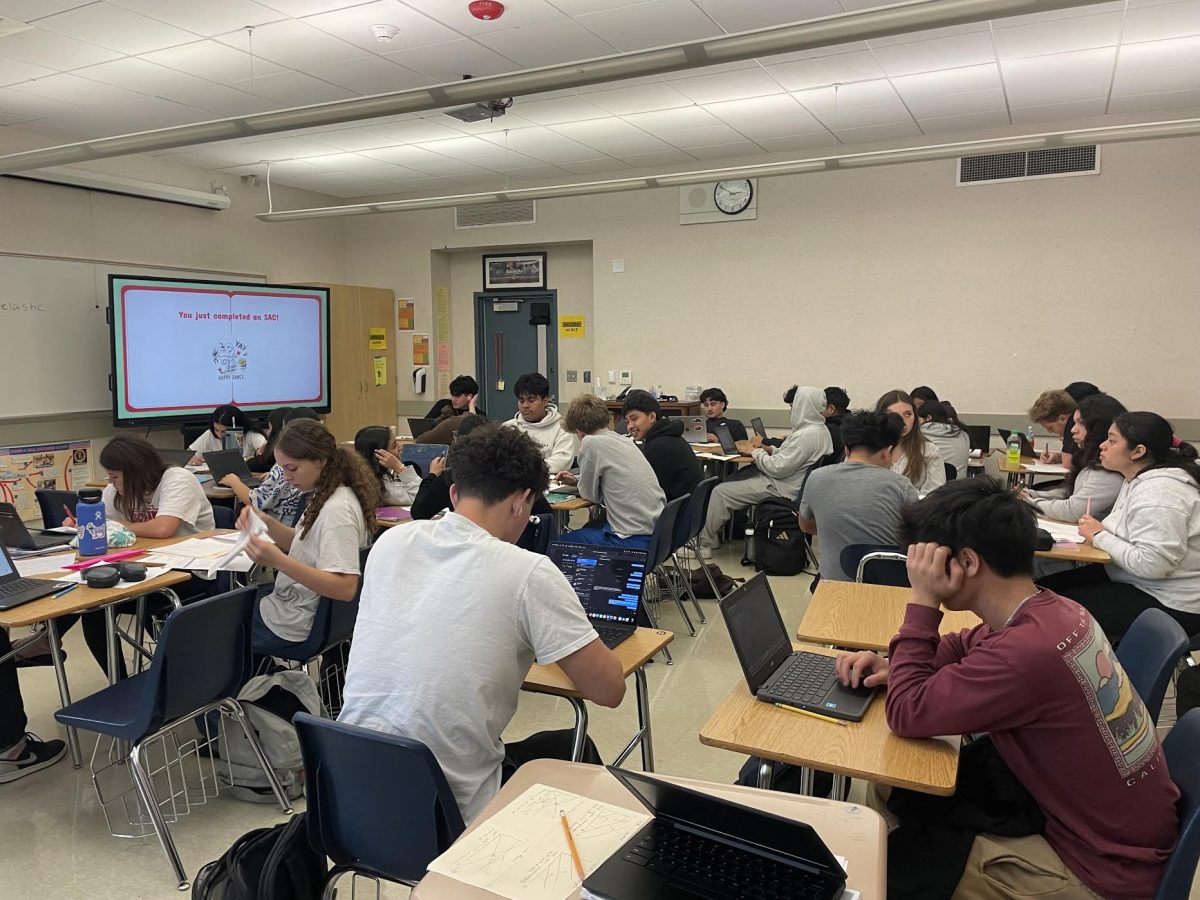
“[Not getting enough sleep] makes it much harder to focus, especially at school,” says SRHS junior Claire Sellers. “I tend to zone out more and it takes longer for me to be able to understand and process things that usually would make sense to me.”
This constant battle is because DST clashes with our fundamental human make-up. Stanford researchers “estimate that permanent standard time would prevent some 300,000 cases of stroke per year and result in 2.6 million fewer people having obesity,” a powerful indication of daylight savings serving as a catalyst for exacerbating the amount of chronic health conditions annually.
There is science that backs up daylight savings also manipulating our mental health. A Danish study conducted research between 1995 and 2012, finding an 11 percent increase in hospital patients who felt depressed after the sun set an hour earlier. Terra Linda High senior Olga Chan adds, “I’ve noticed I feel more tired and less motivated. The lack of sunlight definitely affects my mood, I feel more sluggish during the day.”
The widespread effects of time changes on the Marin community extend far beyond tired teenagers. A 2020 analysis from Current Biology, a peer-reviewed scientific journal, discovered an alarming correlation between traffic accidents and the weeks following daylight savings too, with a six percent spike in car crashes. “As we age, our vision changes and night driving can be a real concern,” says my grandma, Patti Vance. “There have been many instances of students riding bikes home after a sports practice or school function that blend in with the shadows.”
Elderly people are disproportionately impacted by the clock switch, though to what extent it affects them largely depends on their life circumstances. For instance, Sheila Girton, a retired English teacher from Archie Williams High School, says, “When I was teaching, [the time change] affected me more but now that I’m not working, I can sleep for hours.”
Seniors in nursing homes struggle more. The elderly rely on adequate and consistent light cycles to regulate their internal clocks. At these facilities, poor lighting can worsen sleep quality. This is supported by the scholarly journal, Clocks & Sleep’s study in 2020 that investigates these conditions, revealing “circadian rhythms in senior home residents are highly disturbed.”
Another group at risk are children. I have a younger sibling in elementary school who becomes vulnerable during those first days after a switch. The need to wake up an hour earlier results in a rough start to the day.
“I notice [the week after daylight savings happens] some of my students have a hard time sitting on the carpet and would rather lay down while listening to instructions. I also notice some impatience between students over small issues,” says Tonya Bentivegna, a local kindergarten teacher. “I find myself wondering why this week is so difficult and then I realize it probably has to do with the time change.”
So with all the health and public safety risks DST poses, the question remains: why did the measure stick? To understand, we have to travel back in time to the 1700s, where Benjamin Franklin first conceptualized daylight savings while in Paris. He calculated that “Parisians [saved] 96,075,000 pounds of candles annually,” according to an excerpt titled “The Rocky History of Daylight Savings” by the San Francisco Chronicle. He believed it would conserve resources and allow for longer evenings.
A popular myth surrounding daylight savings is that it saves on energy consumption. While this may have been the original rationale for U.S. adoption in the 20th century, modern research suggests it does the opposite. In fact, the California Energy Commission states the time shift had “little or no effect on energy consumption.”
Several factors contribute to this finding. With the sun out later in the warmer months, people tend to use their air conditioning longer into the evening. Additionally, more daylight in the summer encourages people to go out more, leading to greater vehicle emissions. Conversely, in the fall and winter, when mornings are darker and cooler, individuals are more likely to turn on their heating systems earlier.
Concluding the history of DST, the Washington Post says that it wasn’t until World War I that Franklin’s idea took hold. Congress passed a bill that “authorized advancing clocks one hour from in March to the last Sunday in October.” But, it was quickly repealed the next year after opposition from farmers.
The U.S. still had a compelling interest in changing clocks, with influence from other countries’ continued use. By 1966, Congress had passed the Uniform Time Act and most states had daylight savings plans.
In California, the practice has become a subject of intense debate. Former Bay Area assembly member Kansen Chu spearheaded Proposition 7 in 2018, which aimed to establish permanent standard time. “It won support from 60 percent of voters,” according to Patch (a network of hyperlocal news and information websites that cover community news), but the initiative stalled because it required a two-thirds majority in the California senate and subsequent approval from the federal government, neither of which took effect. Last year, California Senator Roger Niello proposed a similar bill, however, it is currently facing the same legislative hurdles that caused the downfall of Prop 7.
Only time will tell if lawmakers will listen. What’s clear is daylight savings isn’t aligning with our natural physiology; rather, it acts as a catalyst for numerous wellness problems. In our modern world, DST is merely an outdated relic. Our bodies and minds shouldn’t be subjected to this measure when current knowledge suggests we know better.
