
















“Grandma” crafts: sewing, reading, crochet, baking, and much more. The quiet, independent hobbies that have been making their comeback as the internet tries to replace the art.
We have probably all seen our grandmothers knit or force us to learn their new recipe, we might have brushed it off, but now their hobbies are more relevant in our lives than before. Picking up a creative hobby can be seen through many different lenses, not just as a past time.
The grandmas were not wrong with taking up crafting; this art connects people and holds tradition.
It’s not just a hobby, it’s history. Handmade crafts date back to 30,000 BC and have only progressed over time. Handmade goods made their boom in the 19th century with the Industrial Revolution and Arts and Crafts Movement demanding more homemade goods from artisans. Handmade spoons, baskets, pottery items, have all been used as an essential part of human history and the backbones of appliances today.
Today, crafts offer a slow and restful hobby, instead of a dire and dependent skill. Taking a break from the world and focusing on a craft is a good way to relax and reduce stress. In an University of Arizona article, written by Thresa Vaughn, Vaughn discusses the benefits of crafting and among those was the reduction of stress. Vaugh writes that, “when you’re immersed in a craft you enjoy, you focus on it and stop thinking, which can help reduce stress.”
Crafting offers a welcoming community and opportunities for friendships. Our communication these days seems to consist of a lot of texting; meaningful, real-life connections are lessening. “Grandma” hobbies provide a fun way to start conversation and meet new people. These past times aren’t always independent, they can be done with friends and family.
Kate Burton, a long-time crafter living on the East Coast, shares her experience working at a yarn shop and how during lessons they would “gather around a big table, knit and chat.”
The internet and the distraction of doomscrolling have taken up the time once dedicated to crafting. Most people’s days are spent in school, or work and in the downtime we have, we are busy with sports or we relax…on our phones. The average screen time of a teenager is 7 hours or more, resulting in 100 days by the end of the year. Although I can’t blame anyone for being on their phone, because I am also victim to scrolling for hours, it is important to balance that with doing a craft. Spend 4 hours on a phone, spend 4 hours practicing a “grandma” craft.
Since the introduction of “Insta Reels” and “Youtube Shorts,” more people have been reaching towards their phone during short breaks and as a past time. Everything seems to be on the phone, school work, communication, shopping; there are constant distractions luring us into the endless pit of the internet.
As a result of this, our attention spans have shortened. The American Psychological Association hosted a podcast with Gloria Mark, a PhD psychologist who dedicates her studies towards the effect of media on people’s lives. Mark states that, “back in 2004, we found the average attention span on any screen to be 2.5 minutes on average. Throughout the years it became shorter. So around 2012 we found it to be 75 seconds. And then in the last five, six years, we found it to average about 47 seconds.” This corroborates the idea that people tend to gravitate towards quicker and exciting entertainment. Unfortunately, this has led to the decline of the slow, and sometimes tedious “grandma” crafts. But this should give all more reason to start up a quiet hobby.
Most projects are time extensive and require focus. As I mentioned, teenagers have faced a decline in their attention spans, which will have repercussions later on. Crafting forces us to slow down and be active, not just passive on a phone. Crocheting doesn’t just need yarn and a hook, it needs a mind ready to learn and actively count stitches. This allows the brain to be calmed, not having to focus on a worldly issue.
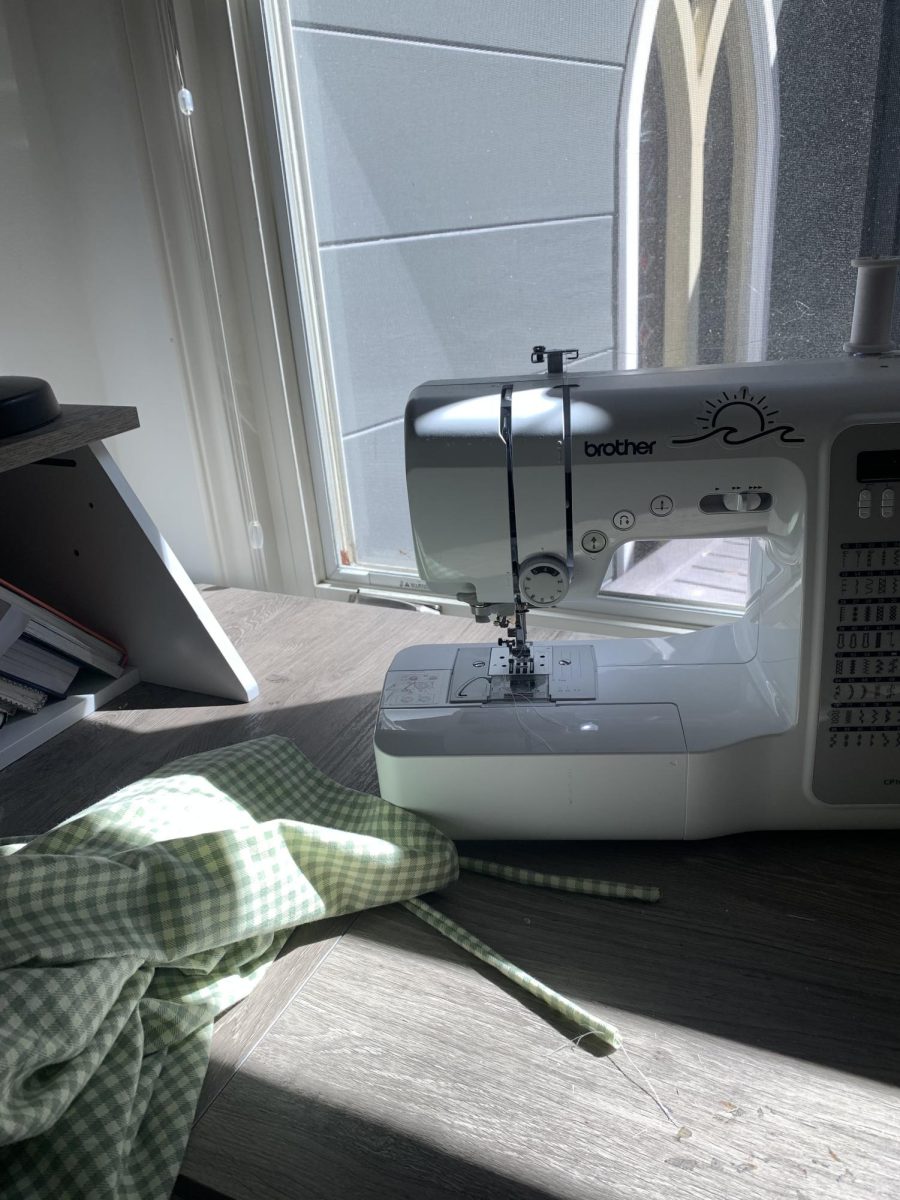
Adriella Gray, a senior at Terra Linda High School who started her sewing journey in high school, says she likes having something to do that is “creative and relaxing.”
A sense of achievement is also a priority nowadays. The majority of Americans look for something that will give them that feeling of accomplishment, usually in work. “Grandma” crafts can easily satisfy that craving. Crafts yield an outcome whether it’s a knit sweater, a chocolate cake, or a blooming sunflower. There is a physical object that rewards much accomplishment.
Many of these tangible, handmade “grandma” crafts are gifted to others, making personalized presents. Adriella says that she likes “how sewing can be used to make meaningful gifts.”
Because I discussed so much about why “grandma” crafts aren’t just crafts, here are some easy craft projects to try.
- Paper Chains. These paper crafts have been the hype on social media for fun and whimsical house decor; they are pretty simple to make too. The materials needed are colorful paper (you can even use old books), a stapler (glue and tape also work), and scissors! That’s it. Steps: Cut the paper into 8-inch by 2-inch long strips and staple in a circle and repeat, including the previous circle in the new one (creating a chain).
- Embroidery. This needle work can be used to personalize any piece of clothing or just be used for decor. It is an independent and solitary craft that is good for mindfulness and focus. Materials: embroidery floss (or thicker thread), embroidery hoop, and a needle. Here are the details and steps.
- Collaging and Scrapbooking. Creating a little photo book for friends or putting together a scrapbook of special memories is a creative way to remember the past. Materials: Old magazines, printed photos, stickers, markers, scissors and any other mediums you want to use. Just start by cutting up images that are interesting and glue them onto a page. There’s no rules, just whatever speaks to you!
Beyond the tangible outcomes of crafting, this hobby is not only about what it creates, but the process. The first sweater is a proud accomplishment, but so is the mindfulness that was rewarded and the new skill acquired.

Nick Burdick • Jan 7, 2026 at 10:59 am
Agreed, there’s something satisfying about seeing the results of your work. There’s nothing at the end of an endless feed.
Focusing on something you enjoy is a great antidote to the erosion of attention.
I enjoyed this.