











I remember the feel of lime green pillows and painted walls at my back, the rough carpet under your fingers as you shifted around in Coleman Elementary’s reading nook. It was a hidden place, where all you could see were shelves of books and the mural of Alice in Wonderland and Winnie the Pooh. Until you got older, and you could see over the walls to the rest of the library, though all it contained were more rows of wonder.
I’d scan the walls of book spines for something I didn’t know. When my class visited, but also during lunch, after school, when I would visit years later and see everything from a much higher point of view. My old world was slanted, tilted up to meet where my eyes now stood. But I’ll remember those shelves, and those books, grubby hands flipping to the middle of a story and counting on my fingers how many words I didn’t know. At the end of two pages, you had to evaluate. If you held up five fingers, the book was too hard, if you held up three or four, you should give it a try, but if you held up two or less the book was too easy. Because that’s the point when you’re little, to grow.
There was a bin by the door, deep blue and empty, its contents artfully spilled over a table: “Libro Gratis.” Books for young hands to grasp at their own pleasure and smuggle home, the feeling of adventure either in taking a piece of school home or in reading the story within it. One of the books had a duplicate, and my teacher nudged my friend and I toward it.
We were always reading the same books, racing to finish one and move on to the next, borrowing from each other to share a world, a story, dragon name pronunciations to fight over and better powers to debate. But we should take our time with this one, said Mr. Jackson. His wrinkled, shaking hands in turn taking their time in running over the cover and handing a copy to me. This one, you’ll like.
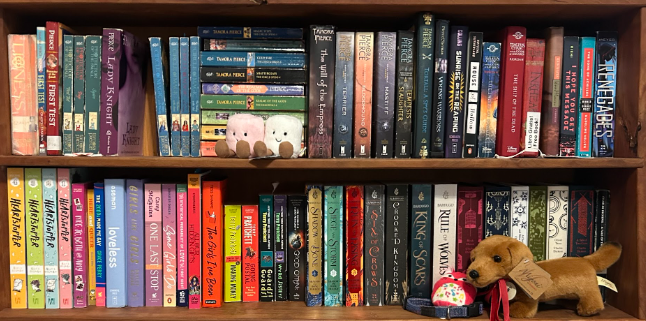
First Test by Tamora Pierce now sits in a place of honor amongst my shelf. My library, the characters that have made me who I am, books annotated, dog eared and perfectly pristine, old notes and bookmarks pressed between pages that have seen my eyes and felt my fingertips for days of my life. It’s held in the loving arms of my other family, the one made of the people who bought me my books, recommended others, who shook their heads as I read by dim flashlights and tell me “I told you so” now that my vision withers. It’s wood from my grandfather’s farm, shaped by my father and brother, polished and shined, a note sprawled on the back, a place I can only read when all my books are stowed in boxes and the screws undone to let the wood breathe. This place is my prized possession.
The last step in my nightly routine is to stand before my library in the dim lights and run my fingers along the spines. I’ve read these books time and time again, and I could flip to a random page in any and explain it to you. But I won’t. I’ll pick one, and I’ll bring it back to bed with me, and I will start at the beginning. My hands look different now as my fingers splay over the pages, but they are busy holding this world dear instead of counting how many words I don’t understand.
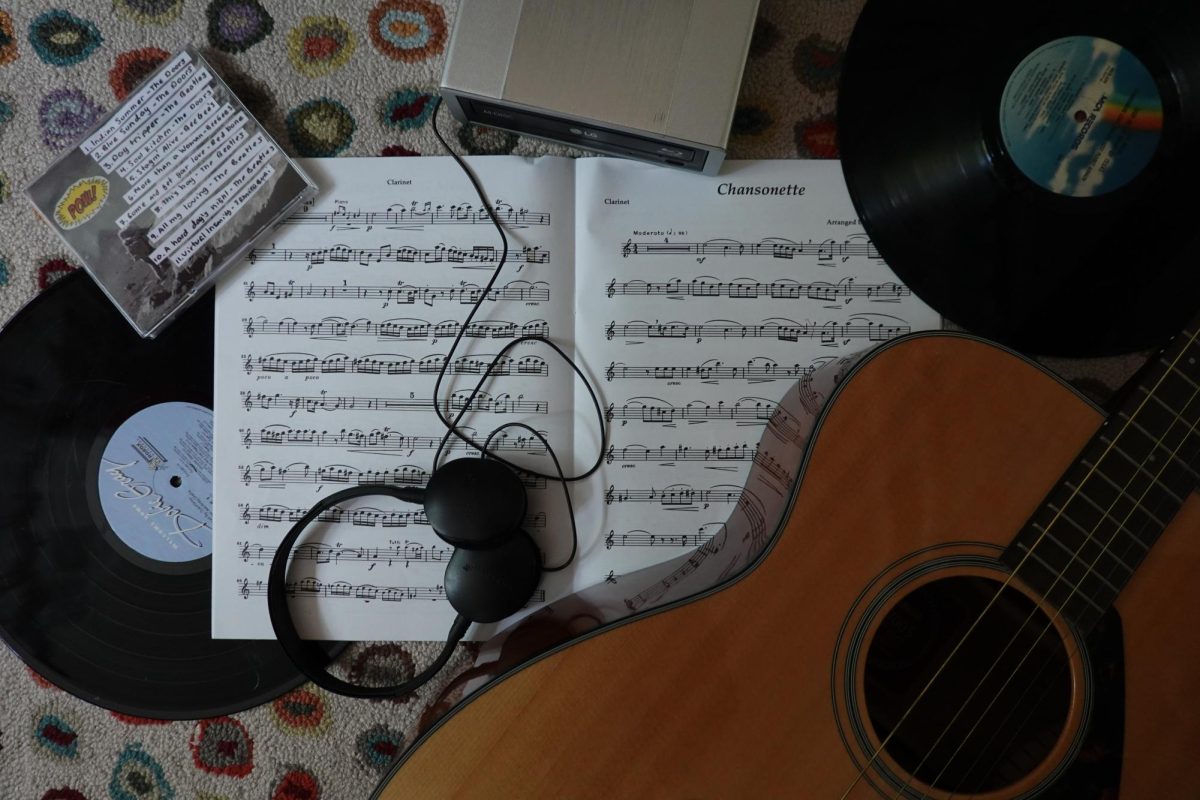
My worship is in the practice of words, told by pen or mouth. So in the day, when I don’t have Tamora Pierce or Tin Tin in my arms, I’m listening to the song of my headphones. It’s me and my public library card, dancing about life as a new world unfolds for me, as narrators describe the lives of my silly little romance novels or my Shakespeare.
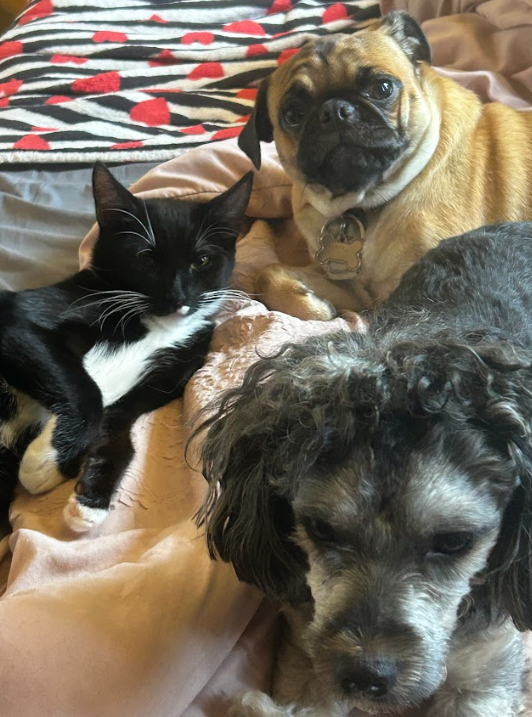
I missed out on reading Percy Jackson when I was in my Young Adult prime, kneeling at the altar of Harry Potter instead, so I decided to read it now. Queued up on Libby, I do chores and paint and pet my dogs to the stories of Greek mythology and wildly neurodivergent teens. The five finger rule has no place here, not when my hands are busy with other tasks.
When I put down a fancy novel, whether it be for learning or for pleasure, and replace it with something I first read when I was barely alive, I often think of my old friend. Friends, really. A whole group of people I’ve met since then, people who shared my passion for reading but perhaps not my principles on it. The friend in fifth grade who would read as fast as possible, the friend in sixth who always treated a story as a test, a challenge of if they could guess the end before they got there. So many friends, who saw it as a means to an end. So many more acquaintances in English classes who thought that a book was only ever a lesson in getting smarter, or proof that they weren’t smart enough. That fifth grade friend eventually grew to be the same, to weigh words as points to their worth.
I pity those that don’t understand that a book is a story, and the point of it is simply to experience it. The fancy words and figures of speech can teach you a lot if you have an open mind, but not nearly enough if you see it only as a mark towards your smarts. I will forever love the way that Shakespeare’s words run around in circles, but I’ll also never stop reading my stories of lady knights and the dragons they befriend instead of slay. Reading is simply for people, not the people who are intelligent or who can absorb words at lightning speed. It is just for the people.