
















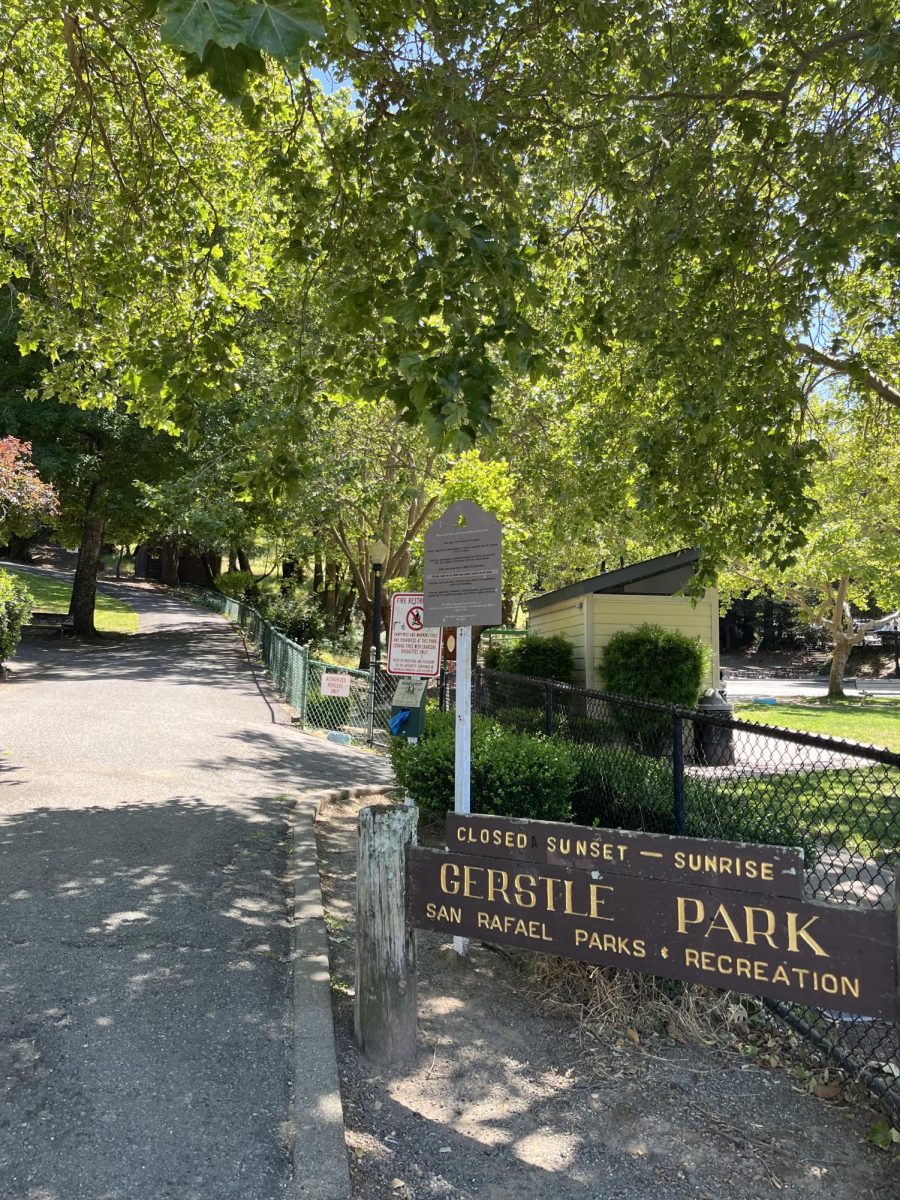
My view on our county’s local parks have drastically changed throughout my life. As a little kid, I remember Gerstle, my neighborhood park, characterized by sunny days and playing with friends without a care in the world. In my teens, however, I recall Gerstle as being run-down, having a poorly maintained bathroom, cracked and broken tennis courts, and the weird homeless men living in the hills above the park, each altering my view.
As a little kid, visiting Gerstle was an almost daily occurrence. My sister and I would walk over to the park, and find some sort of thing to keep us entertained. Everything seemed big back then, the swings were huge, the slide towered over us, the basketball hoop unreachable. We would spend hours climbing, running, swinging, doing whatever we wanted. I don’t remember any of the problems with the park, everything seems perfect, but when I look back at it, they were there, whether I saw them or not.
Being built in the 1930’s, even through updates and refurbishments, Gerstle was showing its age. In the upper parts of the park lies a tennis court, which until 2023, was cracked, damaged, and usually missing a net. The bathroom was covered in graffiti, and the aluminum toilet had all sorts of stuff scratched into it. When walking through the hills of the park, it wasn’t an uncommon occurrence to see tents, piles of trash, or even people sprawled out between the trees. It wasn’t until mid 2024 that I was able to look at the park with the same youthful outlook as I did in the past, and only then did I realize that my changing views reflected the state parks across Marin, which have struggled with aging infrastructure and insecure funding. Unfortunately, this also seems to be happening nationwide.
Towards the end of 2025, amidst the government shutdown, the Trump administration proposed cuts to various programs aimed toward the preservation and upkeep of natural landscapes. The most notable proposal was a $1.2 billion cut to the National Park Service and a 95% cut to the Historic Preservation Fund. While the NPS cut was ultimately denied, these proposals demonstrate the clear decline in the administration’s interest when it comes to nature as a whole. “[The administration] knows what they’re doing, obviously they don’t care about nature as much as anything else, since Trump doesn’t even want to fund them,” Ward said.
Unfortunately, not all of the proposals for cuts were denied, leaving a 72% cut for construction/repairs and a 52% cut to the Environmental Protection Agency still up in the air. The NPS workforce was also cut by ~25%, contrasting the increase in use among the public.
While these changes significantly impact the National Parks, do they impact our local parks? Due to the administration’s disregard for the park systems as a whole, it may show itself in the form of fewer grants nationwide, and ultimately, here too. For instance, the Community Change Grant, a grant aimed to provide environmental justice to disadvantaged communities and fund community programs, was canceled, leaving a hole in the funding many parks rely on.
Luckily, Marin is a very privileged county and funds its parks mainly through Measure A. Measure A is a quarter‑cent sales tax that has a portion dedicated to parks and open spaces. It’s been favored by voters since 2012 and has been very useful when it comes to upkeeping our local parks, as most government grants are meant for underprivileged communities, and Marin is generally considered an affluent county.
According to Catherine Quffa, the San Rafael library and recreation director, San Rafael will receive around $580,000 of Measure A funds, post distribution. So, while most of our park funding stems from Measure A, the one off grants we received might still decrease in quantity.
Prior to 2020, Measure A funds were mostly used for wildfire prevention and vegetation management, but since other funding methods have come into play, it has switched to prioritizing improvements for parks/open space, allowing the City of San Rafael to chip away at longstanding issues they couldn’t before.
Grants are mainly used by the city to do big projects, such as renovations and the construction of new green spaces. The most recent project done was the Pickleweed Park renovation. The Canal area is considered a high‑priority area, as even though there is Pickleweed, it’s a densely populated area, especially compared to the other single‑family‑home neighborhoods in Marin.
“Canal is still a high priority for us to increase park space because the area per capita is lower,” Quffa said. The city received a federal grant for $4.2 million, allowing them to jumpstart the process, as Measure A funding is generally not enough for complete renovations, but mostly maintenance.
Parks such as Pickleweed were prioritized in the refurbishments due to the population living near them. Green space access is one of the major issues that the San Rafael Parks Department takes into account, and with Pickleweed being in the Canal, where apartments with little to no yards are common, this was a priority for the city. “Since there’s not much space at home, going to parks also allows us to hang out with lots of friends or family members, we go out and take my little brothers to fields to play soccer or just run around, “ Marvin Chay Tecun, a senior at SR, said. Parks such as Sun Valley and Gerstle are mostly surrounded by houses with yards or backing many trails and open space, which makes the need for a neighborhood park not as dire. Safety is also considered in these remodels.
“We have a lot of sand playgrounds still, and the sand is not as good for ADA compliance,” said Quffa, “So replacing our sand playgrounds is kind of like one of the priorities.”
The parks’ conditions as of now vary depending on the park and what stage it’s in. Older parks, such as Gerstle, have large grassy areas and forested hills, with minimal play structures, and are therefore not as closely looked at. The current structure there consists of 3 full‑sized swings, 2 play structures—one for older children and one for younger—and a tire swing. A majority of them are on either woodchips or sand.
To update Gerstle’s structures alone, which are about 25 years old, and “that’s gonna be 1.5 or 2 million dollars,” said Quffa. Sun Valley Park, on the other hand, had only one structure and was refurbished for only about $520,000. The most recent renovation, Pickleweed Park ended up costing $7.4 million dollars, replacing two grass fields with turf and replacing a major playground.

In our current climate, parks in Marin seem to be stuck in a sort of doldrums. Although good progress has been made in the past, the future is more unclear than ever before. With budgeting uncertain and many ambitious projects in the works, how parks are approached right now is crucial for their success in the future.
Before the Covid pandemic, people used parks and open space to get outside for fun. But during the pandemic, when people were trapped inside, parks became one of the only ways to access the outdoors and provided vital connections with nature, and a critical way to escape everyday hardships.
“I would go to the park almost every day,” said Ward, when asked about them during the pandemic. “They gave me a way to be free from my house.” In the years since Covid, despite the slight drop in funding, the parks have actually vastly improved.
“When I’m overwhelmed I go outside for walks, or go to the soccer field at the park to run and clear my mind,”Chay said.
Parks are often used as a place to relax and “get away,” especially for those with little outdoor space at home. We’ve likely all done something similar, going outside for the smell of the crisp air when overwhelmed, or just for time to think and ground yourself in what’s real, and parks can provide a safe space for people to do so.
Jared Morales, a senior at SR who lives in Novato, often goes to parks to run. “They’re honestly very fun and it makes me forget about all the stress I have,” he said. The mental aspect of open space highlights a portion of the practicality of parks, as they are both social places and places where people can go to be alone and reflect.
People have begun to use the parks more and more often—either for birthday parties, pickup sports games, or even just to get their kids outside for an hour or two. The benefits of them have led to people enjoying them to the fullest.
While park use has risen nationwide, especially after the pandemic, Morales observes otherwise: “I like rarely see more than like five people, it’s sad.”
But across the county, Quffa corroborates the national trend: “The parks seem to be very busy all the time when I go. So does Chay: “The nearest one to us (Pickleweed) gets crowded all the time.” The differences in experience are an example of how the nature gap is prevalent, even within the same county.
Morales described the area around him as “nothing but houses and roads,” with the nearest park being ~2 miles away from his house. The access he has to open spaces is very lackluster, especially compared to San Rafael. “The parks by my house, nothing compared to [Sun Valley].”
Distance is not the only factor when it comes to inequity within parks. Despite Pickleweed often being crowded, as described by Chay, it’s often a bad crowd: “There are usually men playing cards and drinking at the benches.” Arguably, a bad crowd can do more damage than distance, as the Canal area is made up of mostly multi‑family housing, meaning more people rely on Pickleweed.
While most people immediately notice the cracks within the park system, they don’t realize how stretched out the system really is. San Rafael alone has 26 parks to maintain, and looking at the budget, it’s clear why some things aren’t up to everyone’s expectations. Quffa, the recreation director, says the city is “under‑resourced for the amount of infrastructure that we have,” which has led to a buildup of to‑dos.

Chay described avoiding Pickleweed entirely because at the time “it was in bad condition,” and the field was annoying to play on. He later describes returning post‑renovation and enjoying it even more than before. Because maintenance decisions are based on urgency, such as ADA compliance issues, or faulty infrastructure that can lead to injury, many “upgrades” are put off.
Morales mentioned how it seems nothing has changed around his parks within the 10 years he’s lived there. Still, he agrees with the fact they’ve been maintained, although he does think the bathrooms and water fountains could use an update.
Despite frustrations, people still haven’t given up on their parks. The hope held out for parks only strengthens the idea that these places still matter. Community members constantly describe a vision of parks being safe, clean, and enjoyable for a hopefully larger visitor base. “I want to see, you know, more kids there… it breaks my heart a little bit,” Morales shared.
Quffa sees the same potential, as she’s noticed an increase in usage after major renovations.
Marin County’s parks are heading into a future of high standards: with rising community expectations, aging infrastructure, and funding that hasn’t risen alongside the community’s needs. “We have a lot of deferred maintenance and we’re not able to keep up with it,” Quffa commented. The backlog of maintenance and fixes is what will make up the future, and they do align with the community’s needs, it’s just a matter of what they can do with what they have. The community wants better access and safer playgrounds, but the city is still making its way down the list of repairs and alterations that have accumulated over the years.
When the city asked residents what they wanted most for their parks, the answer was clear: elevate what we already have. “It was very strong, maintaining what we already have,” Quffa explained. That priority shapes the city’s vision, backed by the more steady funding Measure A provides, as opposed to one‑off grants that allow for bigger projects.
Marin’s future isn’t just about upkeep, though. San Rafael has identified various neighborhoods that are considered park‑poor, such as the Montecito/Dominican area, West End, and the Canal. Each area mentioned has either limited access to a greenspace or simply not enough infrastructure to match the population.
The city recently purchased a former boatyard near 101 Surf Sports, with plans to turn it into a new park and potentially build a pedestrian bridge, connecting the Canal and improving access. The pedestrian bridge is a big project, but would positively impact the lives of many and reduce commute times for many SR students by a considerable amount.
San Rafael’s vision is clear, but the path to achieving it is not. San Rafael Parks receives about $580,000 a year from Measure A, but major projects require millions of dollars, and saving while maintaining could take years. The conversion to turf in the Pickleweed Park renovation cost around $5 million alone. “These projects are really expensive… our annual capital budgets are not sufficient,” Quffa said.
Grants can set San Rafael closer to its vision, but they’re very hard to come by, especially for a generally affluent area. “We would never have been able to [do the Pickleweed Park renovation] without the large grant,” Quffa said. Federal funding is rare, and even when it’s available, understaffing slows the process. The city knows what to do; the trouble is finding the resources to act. “Even if we had all the money in the world, we don’t have enough staff to implement the projects at the speed we want,” Quffa added.
The city has experimented with volunteers but finds it’s often not nearly effective enough to implement as common practice. The process requires a lot of outreach and organization so people know what to do and are safe in doing so. Oftentimes, the total amount of work done compared to the setup time makes Quffa question the efficiency: “Is it really about the work that’s being performed versus…the community that you’re building and the goodwill you’re building within the volunteer force?” So, while it’s not very efficient now, the trust built within the community and the hope it can bring may lead to volunteer work being used more often. “I would volunteer, because it’s a large part of our community,” Morales said.
In the end, time will support the communities who need it the most. Neighborhoods that may have been neglected in the past are being highlighted by the community. Both the City of San Rafael and its people know what they want: equity, via clean, safe, and enjoyable parks for everyone. “We would all love to be able to do more,” Quffa says.
Whether the future holds more federal funding cuts, slowing the progress we’ve made, or even an increase in funding, one thing that will stay consistent is the community’s willingness to keep pushing for the parks everyone deserves.